To keep an eye on my services and servers by monitoring how resources are being used and whether something is about to break, I took some time to explore what tools and services exist that are open-source and lightweight. I found that Beszel fits in nicely: it’s quick to deploy and easy to understand.

Continue reading

Recently, I set out to explore how to read and write the memory of a running process in Rust. Programming isn’t just about writing code that runs—it’s also about understanding what happens under the hood. Sometimes it is necessary to understand how memory works, for debugging, or even implement a simple IPC mechanism without going through sockets or shared memory. This experiment turned into a neat experiment that combines Linux internals (process_vm_readv/process_vm_writev), unsafe Rust, and a reminder of why process isolation is such an important security boundary.

Continue reading

For future projects and out of personal curiosity, I want to explore authentication management platforms beyond Keycloak, which I’ve already used. In this post, I’ll take a look at Casdoor, an Identity and Access Management (IAM) and Single Sign-On (SSO) solution with a user-friendly UI, built in Go 😎. I chose Casdoor for its extensive third-party login support, customizable login themes, and a unique payment integration feature. Let’s see how it performs! 🚀

Continue reading

ESP32 Net Sentinel Dongle

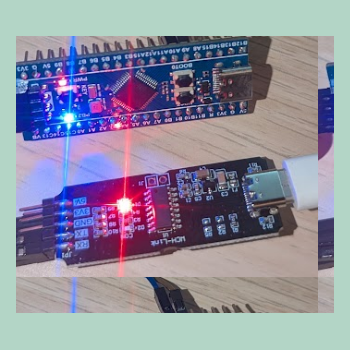
To sharpen my Rust skills for embedded systems, I embarked on creating a project that uses Discord (and soon MQTT) to receive commands for network tasks. Users can monitor devices, perform network scans, execute pings, send WOL packets and get alerts when applications running on edge devices fail.

Continue reading

SVG animation

Recently, I needed to create some animated diagrams and discovered that it’s possible to animate SVG images directly within the SVG element itself. However, the process isn’t exactly straightforward. To simplify it, I decided to write this blog post to share my findings. I even developed a tool to make building SVG animations easier, which I’ll introduce as well.

Continue reading

I am preparing a new series of blog posts about my home server setup using an old Dell Latitude 5490. This setup is designed to power on when a smart plug activates and to shut down safely when the plug turns off. To achieve this, I configured the BIOS settings (power on) and set up a cronjob for Proxmox (power off). This blog series will cover these configurations and the overall process.

Continue reading

Author's picture

David Melo

engineer and a techie

Telco Engineer

Portugal